
Put on the 1928 recording of "West End Blues" and time the opening. You get about twelve seconds of solo trumpet before the band arrives. Twelve seconds. That's shorter than most people spend deciding whether to keep reading a homepage. And yet musicians have spent nearly a century trying to unpack what Louis Armstrong did in that span.
I'm not a jazz historian. I build websites for a living. But I keep coming back to this record because it's the clearest example I know of a craftsman taking ordinary material and doing something with it that reorganizes an entire field. If you want to understand what mastery actually sounds like — not talent, not novelty, mastery — this is where I'd start.
The song wasn't his, and it wasn't much
Here's the first thing that surprises people. Armstrong didn't write "West End Blues." His old mentor Joe "King" Oliver did, and Oliver recorded it first, a few weeks earlier in 1928. It's a perfectly fine tune named after a resort spot on Lake Pontchartrain, near New Orleans, where people went to drink and dance by the lake.
As a piece of composition, it's modest. A twelve-bar blues, which is about as standard a structure as exists in American music. Three lines, a predictable chord movement, the kind of form a thousand other songs share. There's nothing in the sheet music that tells you it's going to become a landmark.
That's the part worth sitting with. Armstrong took a stock form, written by someone else, already recorded by someone else, and turned it into arguably the most important three minutes in early jazz. The raw material was average. The execution was not.
I think about this constantly in my own work. Clients hand me the same components everyone has — a nav, a hero, a contact form, a grid of services. The building blocks are commodities. Anyone can buy the same theme. What separates good work from forgettable work is almost never the ingredients. It's what you do with the twelve bars everyone already has.
Those first twelve seconds
The record opens with Armstrong alone. No rhythm section, no clarinet, no piano. Just an unaccompanied trumpet cadence that climbs and tumbles and hangs in the air with a kind of confidence that had never really been put on a jazz record before.
It's not a melody in the ordinary sense. It doesn't state the tune. It's more like a declaration — a run of notes that establishes, before the band has played a single beat, that you are listening to someone in complete command of the instrument. When the rest of the group comes in behind him, the frame has already been set. He owns the room.
The critic Gunther Schuller, who took jazz seriously as an art form when a lot of academics wouldn't, wrote about that opening in his book Early Jazz. He argued that two things about the performance made it impossible for jazz to go back to being mere entertainment: the beauty and originality of Armstrong's melodic thinking, and the near-perfection of every part of the performance. Not one part. Every part.
What gets me about the cadence is how deliberate it is while sounding spontaneous. It feels like an outburst, like something that just fell out of him. It wasn't. Armstrong worked. He played this material night after night on the bandstand before it ever reached a microphone. The looseness is earned. The freedom is built on top of thousands of hours of repetition until the hard parts became reflexes.
Why the intro still matters
Trumpet players still learn to play that opening note for note. It became a set piece, a rite of passage, a thing you have to be able to execute. That alone tells you something. A twelve-second improvisation became a canonical text that later musicians study like a poem.
The lesson isn't "start with a bang," even though he did. The lesson is that the opening establishes the standard everything after it has to meet. Armstrong didn't play a flashy intro and then coast. The intro promised something, and the next three minutes delivered on the promise. That's the hard part. Anyone can make a loud entrance. Backing it up is the whole game.
Who else was in the room
It would be easy to talk about this as the Louis Armstrong show. It wasn't, and pretending it was would miss half of what makes the record great.
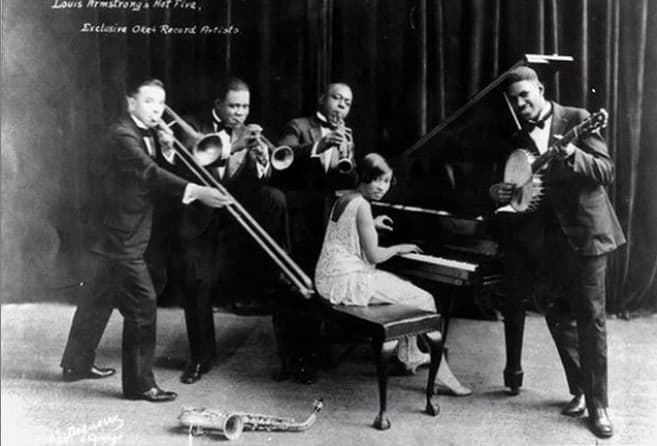
The session was billed as Louis Armstrong and His Hot Five, recorded for OKeh in Chicago on June 28, 1928. But the personnel had shifted from the earlier Hot Five records. On this one you've got Fred Robinson on trombone, Jimmy Strong on clarinet, Mancy Carr on banjo, Zutty Singleton on drums, and — this matters — Earl Hines on piano.
Hines was Armstrong's equal in a way few musicians were. He played the piano with a right hand that mimicked the phrasing of a horn, so-called "trumpet-style" piano, which meant he could go toe to toe with Armstrong instead of just comping chords underneath him. Put two players of that caliber in one room and the record stops being a solo showcase. It becomes a conversation.
The piano solo
About two-thirds of the way through, Hines takes over. His solo is dense, rhythmically slippery, and completely different in texture from Armstrong's playing. Where Armstrong is broad and singing, Hines is angular and darting. The two of them aren't trying to sound alike. They're trying to complement each other, and the contrast is the point.
This is what a real collaboration sounds like. Not everyone doing the same thing at once, but distinct voices that make each other better. I've worked on projects where a developer, a copywriter, and a designer each pulled in the same direction and the whole thing felt flat. And I've worked on projects where the tension between different strong opinions produced something none of us would have made alone. "West End Blues" is the second kind.
The wordless vocal
There's a moment in the middle where Armstrong puts down the trumpet and sings — but not words. He scats a slow, aching phrase, trading lines with Jimmy Strong's clarinet. It's call and response between a human voice and a reed instrument, and the human voice is doing something no voice was really doing on record at the time.
Armstrong more or less invented the popular vocabulary of scat singing, and while he'd recorded scat before, this passage is different. It's not comic or showy. It's tender. He's using his voice like a horn, bending notes, phrasing behind the beat, treating the absence of words as an opportunity rather than a gimmick.
What strikes me is the restraint. He could have blown the roof off. Instead he pulls back and sings something quiet and vulnerable right in the middle of a record that opens with a fireworks display. The dynamics are the story. Loud, then soft, then loud again. He understood that contrast is what makes intensity readable. You can't have a peak without a valley.
The last chorus
Then Armstrong picks the trumpet back up for the final chorus, and this is where it all pays off. He holds a single high note — a B-flat — for what feels like an impossibly long time. Something close to four bars. It just sits there, ringing, while the harmony shifts underneath it, before he finally releases into a cascade of notes that resolves the whole performance.
Physically, holding that note is hard. It takes breath control and embouchure strength that most players never develop. But the reason it lands isn't athletic. It's structural. He's been building tension the entire record, and that held note is the moment he cashes it in. The listener has been waiting for release without knowing it, and he makes them wait a beat longer than is comfortable, and then he gives it to them.
That's timing. Not speed — timing. Knowing exactly how long to hold before you resolve. It's the difference between a punchline that kills and one that dies, between a page that feels effortless and one that feels off in a way people can't name.
Why one recording changed the direction of the music
Before Armstrong, most jazz was collective. New Orleans style put several instruments playing counterpoint at once, weaving lines together, with no single voice dominating. It's a beautiful sound and a fundamentally democratic one. Nobody's the star.
"West End Blues" is a hinge point away from that. The record is organized around the soloist. The band is there, and they're excellent, but the architecture of the performance is built to feature individual voices making individual statements. Armstrong's intro, Hines's solo, the vocal, the final chorus — these are set pieces for specific players, not a group blend.
That shift, from ensemble to soloist, is the direction jazz would travel for the next several decades. The improvising soloist becomes the center of gravity. Bebop, cool jazz, hard bop, all of it descends from the idea that a single player working through a set of chord changes can be the main event. You can draw a line from this 1928 record straight through to Charlie Parker and John Coltrane.
One recording didn't cause all of that by itself. History doesn't work that cleanly. But if you're looking for the moment the possibility became undeniable, this is a strong candidate. It's the proof of concept.
The technical quality is part of it
Something people underrate: the performance is clean. In an era when a lot of recorded jazz was rough around the edges — flubbed notes, ragged ensemble playing, intonation problems — "West End Blues" is polished. The band is tight. The solos are considered. Nobody's coasting.
Schuller's point about "the incredible perfection of every part of the performance" is the part that gets lost when people romanticize jazz as pure spontaneous magic. Yes, it's improvised. But it's improvised by people who had internalized the material so thoroughly that they could be spontaneous and precise at the same time. Those aren't opposites. Precision is what buys you the freedom to improvise without falling apart.
I'd argue that's true of any craft. The most fluid, natural-looking work usually comes from the people who've done the unglamorous reps until the fundamentals are automatic. The ease is a symptom of the discipline underneath it.
What I actually take from it
I'm going to resist turning a jazz record into a listicle of business tips, because that would cheapen it and Armstrong deserves better. But there are a few things this recording has genuinely changed about how I think about my own work, and they're worth naming plainly.
The first is that the material almost never determines the result. Everybody's working with the same twelve-bar blues, the same components, the same tools. The record doesn't stand out because Armstrong had access to something nobody else had. It stands out because of what he did with the ordinary thing everyone had. That's oddly freeing. It means the excuse "I didn't have the right resources" is usually a story we tell ourselves.
The second is that command comes before freedom. The improvisation only works because the fundamentals were automatic. If you want to be loose, you have to first be so solid that looseness doesn't cost you anything. The people who look effortless put in the reps you didn't see.
The third is about contrast. The record is loud then soft then loud. It has a spectacular opening and a quiet, vulnerable middle. The extremes make each other legible. Work that's all intensity reads as noise. Work that's all restraint reads as timid. The good stuff moves between the two on purpose.
And the last one, the one I keep circling back to, is that a small thing done at the highest possible level can outlast almost everything around it. Twelve seconds of trumpet, three minutes total, recorded in an afternoon in 1928, and people still study it, still play it, still argue about it. Nobody remembers most of what was recorded that year. They remember this because it was better, not bigger.
Go listen to it. Not as background, actually listen, with the timer running on that opening. Then ask yourself when the last time was that you made something you'd be comfortable having examined that closely, ninety years from now. That question is the whole reason I keep this record close.