
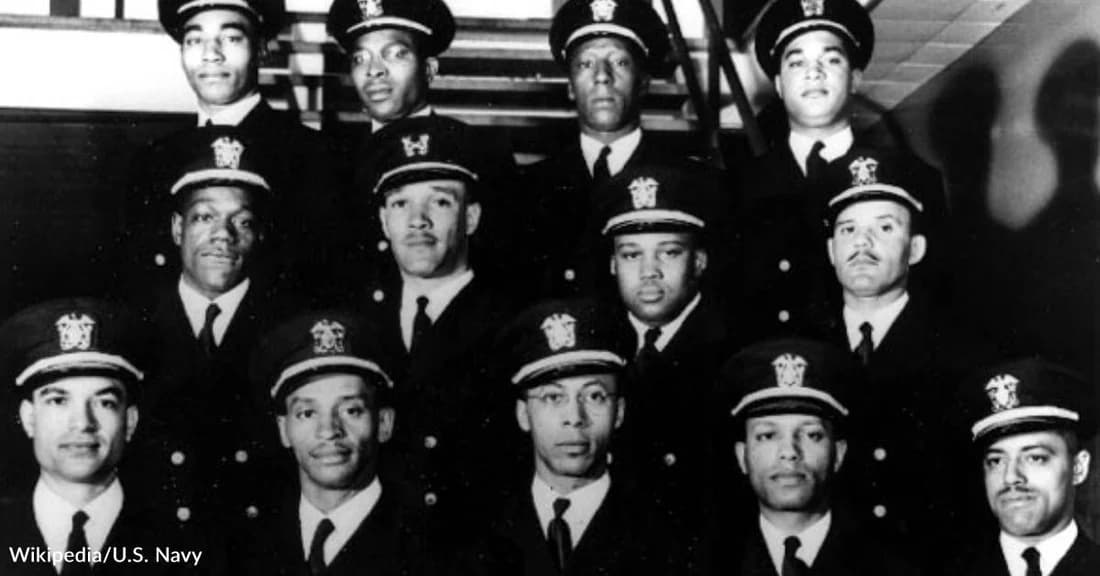
Most people can't name a single one of them. Thirteen men, commissioned as the U.S. Navy's first Black officers in March 1944, and the group didn't even get its now-famous nickname until decades later. That's the part that gets me. They cracked open an institution that had spent more than a century telling Black sailors they were fit to cook and clean and nothing else — and they did it so thoroughly that the Navy accused them of cheating. Then history mostly forgot to write their names down.
So let's write them down. But first, the setup, because the achievement doesn't land unless you understand exactly how locked the door was.
The Navy Black sailors were allowed to have
For most of its history, the United States Navy didn't ban Black men outright. It did something quieter and, in some ways, more insulting. It let them enlist — into one job.
By the 1930s, if you were Black and joined the Navy, you were a messman. A steward. You cooked officers' meals, served them, cleaned their quarters, shined their shoes, did their laundry. During battle you might haul ammunition. That was the ceiling, and it was a hard ceiling. No gunnery. No navigation. No engineering. And absolutely no commission.
Think about what that means in practice. A Black man could serve twenty years, be smarter and more capable than every officer he served breakfast to, and retire having never been allowed to give an order. The system wasn't designed to find talent. It was designed to make sure talent stayed invisible.
Dorie Miller is the example everyone eventually learned about. At Pearl Harbor on December 7, 1941, Miller was a ship's cook aboard the USS West Virginia. When the attack came, he carried his wounded captain to safety and then manned an anti-aircraft gun he'd never been trained to use, firing at Japanese planes until he ran out of ammunition. He got the Navy Cross for it. He never got promoted out of the mess. He died in 1943 when his next ship was torpedoed, still a cook.
That was the Navy in 1943. A man could earn the service's third-highest honor for valor and still be barred from the job his heroism proved he could do.
The pressure that forced the door
Doors like that don't open because someone inside has a change of heart. They open because the pressure outside gets too expensive to ignore. That's the honest version of how the Golden Thirteen happened.
The war created a manpower problem. The Navy needed bodies, millions of them, and the mess-only policy was starting to look absurd when the country was drafting every able man it could find. At the same time, civil rights leaders had spent years pushing hard on the Roosevelt administration. A. Philip Randolph, the labor organizer, had threatened a march on Washington in 1941 that pushed FDR to bar discrimination in defense industries. The pressure kept building.
Secretary of the Navy Frank Knox was a roadblock. He genuinely did not want to integrate, and he said so. But there were people around him — including Adlai Stevenson, then his assistant, and later James Forrestal, who succeeded Knox — who understood the writing was on the wall. Eleanor Roosevelt applied her own steady pressure. The NAACP kept the issue in the press.
In April 1942 the Navy began accepting Black sailors into general service — not just the mess. That was step one. But general service isn't leadership. Enlisted men still answered to white officers. If the Navy was going to have Black units, someone had to lead them, and the political calculation shifted toward a hard truth: it would look better to have Black officers leading Black sailors than to keep the whole chain of command white.
So in January 1944, the order came down. Sixteen enlisted men would be pulled from the ranks and trained as officers at Great Lakes Naval Training Station in Illinois. It was, to be blunt, a controlled experiment. The Navy wanted to see if it could be done without embarrassing itself. The men selected understood they were being tested — not as individuals, but as a proof of concept for an entire race.
Sixteen men in one barracks
The sixteen were chosen carefully. Most were college-educated at a time when that was rare for anyone, Black or white. Several had been teachers, athletes, professionals in civilian life. The Navy wasn't going to run this experiment with marginal candidates. It stacked the deck — which tells you the brass had a decent idea of what these men could do and wanted no excuses if it worked.
They were trained in segregation, of course. The white officer candidates trained in their own facilities. The Black candidates were put together in a single barracks, given roughly ten weeks of instruction, and left largely to themselves after hours. In some tellings they had less classroom time than the standard course.
Here's the part that matters. Rather than compete with each other for a limited number of slots, they made a pact. They would study as a group. The strong students in navigation would tutor the weak ones. The men who understood seamanship would drill the men who didn't. They pooled everything they knew, quizzed each other late into the night, and refused to let any single member fall behind.
That's a strategic decision most people wouldn't make under that kind of pressure. When you're being graded and only some of you might make it, the natural instinct is to protect your own position. They did the opposite. They bet that lifting everyone was the surest way for anyone to succeed. And they were right.
The 3.89 that broke the curve
When the final exams came back, the class posted an average of 3.89 out of 4.0. That's not just good. That's one of the highest class averages in the history of Navy officer training, and it was set by the men the Navy had spent a century insisting couldn't do the work.
The Navy's response tells you everything about the world these men were operating in. The scores were so high that the brass suspected cheating. So they made the class retake the exams under tighter conditions.
They scored higher the second time.
Sit with that for a second. Their reward for excellence was an accusation. Their answer to the accusation was more excellence. They didn't argue, didn't file a grievance, didn't stage a protest — they just took the test again and beat their own record, which was the only argument the situation would actually accept. That's discipline under a kind of pressure most of us will never face.
Even then, the Navy hedged. Of the sixteen, thirteen were commissioned. Twelve became ensigns and one, Charles Lear, was made a warrant officer. Three of the original sixteen weren't commissioned at all, and the reasons have never been fully clean or documented. So the group that made it through — the men we now call the Golden Thirteen — earned their commissions with scores that should have made the outcome a formality and still didn't get a formality.
The names
Since the whole point of this post is that nobody remembers them, here they are. These are the thirteen men commissioned in March 1944:
Jesse Walter Arbor
Phillip George Barnes
Samuel Edward Barnes
Dalton Louis Baugh
George Clinton Cooper
Reginald Ernest Goodwin
James Edward Hair
Charles Byrd Lear (warrant officer)
Graham Edward Martin
Dennis Denmark Nelson
John Walter Reagan
Frank Ellis Sublett
William Sylvester White
Teachers, a lawyer, athletes, a mortician, men who'd built ordinary respectable civilian lives and put them on hold to become an experiment the Navy didn't entirely want to run. Every one of them knew that if they failed, the failure would be pinned on their entire race and used as ammunition for years. That's the weight they carried into those exams.
Commissioned, and then sidelined
Here's where the story stops being triumphant and gets more honest, which is exactly why it's worth telling.
Getting the commission didn't get them command. The Navy had proven it could make Black officers. It was in no hurry to actually use them the way it used everyone else. Most of the Golden Thirteen were handed shore duty and logistics roles. Tugboats. Training assignments. Harbor craft. Administrative posts. The kinds of jobs that kept them away from combat commands and away from authority over white sailors.
They wore the same uniform and held the same rank, but the assignments made clear the institution still didn't fully accept what it had just done. A white ensign with a 2.5 average could expect a path toward real responsibility. A Black ensign with a 3.89 got a tugboat.
Some of them left the Navy after the war and went back to civilian careers — law, education, business. A few stayed. Dennis Nelson made a real career of it, remained in the Navy, was promoted to lieutenant commander, and spent years pushing the service on integration from the inside. He later helped document the whole effort, which is part of why we know as much as we do.
I want to be clear about something, because it's easy to make history tidy. These men did not walk out of Great Lakes into a Navy that respected them. They walked into a Navy that had checked a box and hoped they'd stay quiet in the corner it assigned them. Their real achievement wasn't just passing the course. It was being the wedge that kept the door from swinging shut again.
What their scores made possible
The Golden Thirteen didn't desegregate the Navy by themselves. What they did was remove the excuse.
Once thirteen Black men had posted a 3.89 in officer training — twice — the argument that Black sailors couldn't handle command was dead. It didn't matter that plenty of people kept making the argument anyway. The evidence was on the record, in the Navy's own files, in its own exam results. You can't un-prove something like that. Every future policy debate had to reckon with the fact that it had already been done, and done exceptionally.
The changes came in stages after that. More Black officers were commissioned. In 1945 the Navy commissioned its first Black woman officer, Harriet Ida Pickens. The service began, slowly and reluctantly, to integrate its ships and its facilities. And in 1948, President Truman signed Executive Order 9981, which ordered the desegregation of the entire armed forces. The military integrated years before large parts of American civilian society did — before the schools, before the lunch counters, before the buses.
The Golden Thirteen were the crowbar under that whole sequence. Not the finish. The start. But the start is the hardest part, because the start is the one that gets accused of cheating.
Why "Golden Thirteen"
Here's a detail I find telling. The men didn't get the name in 1944. For decades they were just an obscure footnote, a Navy first that even the Navy didn't make much noise about. The nickname "Golden Thirteen" didn't take hold until the 1970s and into the 1980s, as the surviving members were tracked down and their story was finally documented properly.
The Navy eventually came around to honoring them. There's a recruit barracks at Great Lakes named for the Golden Thirteen — fitting, since that's where they earned it. Their portraits and story are part of Navy heritage now. Some of the surviving members were brought back for ceremonies and recognition late in their lives, which is bittersweet. Recognition that arrives thirty and forty years after the fact is real, but it's also a quiet admission of how long the silence lasted.
That gap between what they did and when they were credited is the most human part of this story to me. Excellence doesn't guarantee acknowledgment. Sometimes it guarantees suspicion first, indifference second, and credit only if someone bothers to go looking decades later.
The takeaway
I write mostly about building things — websites, systems, the work I do for clients. This isn't that. But there's a reason this story stuck with me enough to write about it, and it comes down to two decisions those men made under pressure most of us will never touch.
The first: they refused to compete when cooperation was smarter. Sixteen men, limited slots, everything on the line, and they chose to teach each other instead of racing each other. That's counterintuitive, and it's why the whole group posted a 3.89 instead of a handful of stars and a lot of casualties. When the stakes are high, the reflex is to protect your own spot. They understood that the surest way to win as an individual was to make the whole group undeniable.
The second: when they were accused of cheating, they took the test again. They didn't waste energy litigating the insult. They just produced the result a second time, cleaner, and let it speak. That's the response of people who understood that the only proof the world would accept was proof it couldn't argue with.
So do the thing well enough that the record speaks for you, and lift the people next to you while you do it. Recognition may come late or not at all. The Golden Thirteen mostly got theirs late. But the door they forced open never closed again, and thirteen names — Arbor, Barnes, Barnes, Baugh, Cooper, Goodwin, Hair, Lear, Martin, Nelson, Reagan, Sublett, White — are the reason it stayed open. Now you know them.