
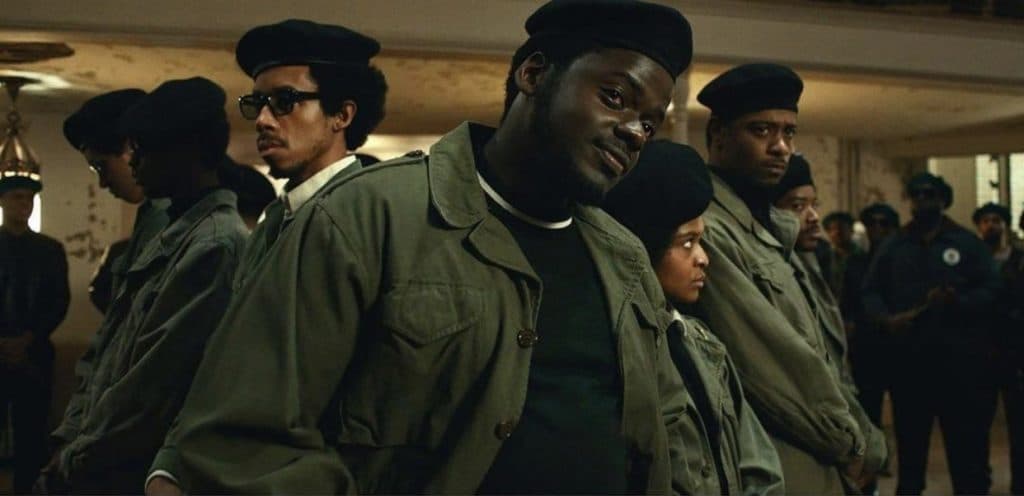
I watched Judas and the Black Messiah three times before I felt like I understood what it was actually doing. The first time I watched it as a thriller. The second time I watched it as a history lesson. The third time I watched it as a warning. All three readings hold up, which is rare, and it's why the movie sticks with you long after the credits.
Most biopics soften their subject to make them palatable. They round off the edges, cut the politics, and give you a hero who wanted vague things like "justice" and "equality." Shaka King's 2021 film refuses to do that with Fred Hampton. It keeps the socialism. It keeps the guns. It keeps the fact that Hampton was, at 21 years old, organizing across racial lines in a way that terrified the most powerful law enforcement agency in the country. And then it shows you exactly how they killed him for it.
That refusal to sand down the real story is why the movie matters. So I want to walk through what the film gets right about Fred Hampton's life, where it compresses or bends the truth for the sake of storytelling, and why the gap between the two is smaller than you'd expect from Hollywood.
The man the film is actually about
Here's the first thing that surprised me. The movie is called Judas and the Black Messiah, and the marketing leaned hard on Daniel Kaluuya as Fred Hampton. But the film isn't told from Hampton's point of view. It's told from the point of view of William O'Neal, the FBI informant who betrayed him. LaKeith Stanfield plays O'Neal, and he's the character we follow scene to scene.
That's a deliberate choice, and it's the right one. If you tell the story from Hampton's side, you get a martyr. Clean, inspiring, safe. By telling it through the eyes of the man who sold him out, King forces you to sit inside the moral collapse. You watch a person make small compromises that add up to murder. You watch the machinery of betrayal work from the inside.
So the "Black Messiah" of the title is Hampton, but the movie is really an anatomy of the Judas. That structure keeps the whole thing from becoming a hagiography, and it's the smartest decision in the film.
Who Fred Hampton really was
Fred Hampton was born in 1948 and grew up in Maywood, a suburb west of Chicago. Before he ever joined the Black Panther Party he was already an organizer. He ran a youth chapter of the NAACP and got the town to build a swimming pool, because Black kids in the area had nowhere to swim. That's not a footnote. That's the entire pattern of his life in miniature: identify a concrete need, organize people, get a concrete result.
By 1968 he'd joined the Illinois chapter of the Black Panther Party, and within a year he was its chairman. He was 20. By 21 he was deputy chairman of the national party and being groomed for a central role. Then he was dead.
The compression there is almost hard to believe. Everything you see in the film — the speeches, the coalition-building, the breakfast programs, the surveillance, the assassination — happened inside a window of roughly two years. The movie captures that velocity well. Hampton moves fast because he had no idea, and every idea, that his time was short.
The speeches were real, and Kaluuya earned the Oscar
Kaluuya won Best Supporting Actor for this, and the win was justified by the oratory scenes alone. Hampton was a genuinely great public speaker, and there's real footage of him you can watch. The cadence, the call-and-response, the way he'd build a crowd from a murmur to a roar — Kaluuya studied it and reproduced it.
The famous lines in the movie are close to things Hampton actually said. "You can kill a revolutionary, but you can never kill the revolution." "I am a revolutionary." "Where's the proletariat? There it go." These weren't invented for the screen. Hampton talked like that at 21, in front of rooms full of people, on the record.
What the film gets right is that his charisma wasn't a performance layered on top of politics. The charisma was the politics. He could make socialist theory land for people who'd never read a page of it, because he tied every idea to something you could see and touch in your own neighborhood.
The Rainbow Coalition, which is the part everyone forgets
If you take one thing away from the film, take this. Fred Hampton's most dangerous idea wasn't Black liberation on its own. It was solidarity across race and class.
In 1969 Hampton built what he called the Rainbow Coalition. Not the later Jesse Jackson organization that borrowed the name — the original. He brought together the Black Panthers, the Young Lords (a Puerto Rican group), and the Young Patriots, who were poor white migrants from Appalachia. The Young Patriots wore Confederate flags on their jackets. Hampton sat down with them anyway, because his analysis said the enemy was class and power, not skin color.
The film shows this, and it's one of the most important sequences in it. Watching Hampton win over a room of working-class white Southerners by talking about landlords and cops and poverty is more radical than any scene with a rifle in it. That's the thing that made him a threat. A Black revolutionary who could unite the Black poor with the white poor with the Latino poor was a nightmare for anyone whose power depended on keeping those groups at each other's throats.
J. Edgar Hoover understood this precisely. Which brings us to the other half of the story.
COINTELPRO and the "Black Messiah" memo
The movie opens with real audio and framing around Hoover and the FBI's Counter Intelligence Program, COINTELPRO. This is not dramatic license. COINTELPRO was a documented, real program aimed at surveilling, infiltrating, discrediting, and disrupting political organizations the FBI considered subversive. The Black Panther Party was a primary target.
The title of the film comes straight from an actual FBI directive. In a 1968 memo, Hoover wrote that the Bureau's goal was to "prevent the rise of a messiah who could unify and electrify" the Black movement. He named names. He was explicit that a charismatic unifier was the single greatest danger, more than any individual act of violence.
Sit with that for a second. The stated fear wasn't crime. It was unity and eloquence. The film treats this memo as its thesis, and it's not exaggerating. The document exists. You can read it.
Martin Sheen plays Hoover, and the movie uses him in a chilling scene where he asks Roy Mitchell, the FBI agent handling O'Neal, what he'd do if his own daughter brought home a Black man. It's designed to strip away any pretense that this was about ideology or public safety. Underneath the anti-communist language, it was raw racial panic dressed up as national security.
William O'Neal and the price of a betrayal
O'Neal's story is where the film does its most careful work, and where I think it's most honest.
The real William O'Neal was a small-time car thief. He got caught impersonating a federal officer to steal cars, and the FBI offered him a deal: infiltrate the Chicago Black Panthers, or go to prison. He took the deal. The movie opens with almost exactly this, and it's accurate.
What makes it tragic rather than simply evil is that O'Neal was good at it. He rose to become head of security for the Illinois chapter. He was trusted. He was close to Hampton. And the closer he got, the more useful he was to the FBI, and the more money he was paid.
The film doesn't let O'Neal off the hook, but it also refuses to make him a cartoon. Stanfield plays him as a man who's constantly calculating, constantly afraid, and occasionally, horribly, sincere. There are moments where you can see he actually believes in what the Panthers are doing, right before he goes and reports on them. That contradiction is the whole movie.
The floor plan
Here's the detail that turns the story from surveillance into murder. O'Neal provided the FBI with a hand-drawn floor plan of Hampton's apartment. That floor plan was used to plan the raid that killed him. The film shows this, and it's documented fact.
The plan showed exactly where Hampton slept. In the raid, the majority of the gunfire went into that bedroom.
December 4, 1969
The assassination is the climax of the film, and it's the part where accuracy matters most, so let me be specific about what's known.
In the early hours of December 4, 1969, a group of officers attached to the Cook County State's Attorney's office raided Hampton's apartment. Fred Hampton was 21. His fiancée, Deborah Johnson — later known as Akua Njeri — was in bed next to him, about eight and a half months pregnant with their son. Mark Clark, another Panther, was in the front room and was killed almost immediately.
The official story at the time was that the Panthers opened fire and the police returned it in a shootout. That was a lie. Later investigations established that of the roughly ninety shots fired, all but one came from the police. The Panthers fired a single round, likely from Clark's gun as he was hit.
Hampton was drugged. The night before, O'Neal had put a barbiturate, secobarbital, into Hampton's drink. During the raid Hampton never fully woke up. Deborah Johnson later described being pulled out of the room and hearing officers say something to the effect of "he's barely alive," followed by two more shots, followed by "he's good and dead now."
The film stages this sequence carefully and doesn't sensationalize it. It doesn't need to. The facts are as damning as any invented drama could be. Hampton was shot twice in the head at point-blank range while unconscious in his bed next to his pregnant fiancée. This wasn't a shootout. It was an execution planned with a floor plan drawn by a paid informant.
Where the film bends the truth
I'm not interested in praising a movie uncritically, so let me be straight about what it changes.
The biggest compression is time and relationships. The film telescopes events and streamlines the cast so you can follow the emotional throughline. Real organizing is messy and involves dozens of people; the movie narrows it to a handful of clear characters so O'Neal's arc stays central.
The romance between Hampton and Deborah Johnson is real and their son, Fred Hampton Jr., is real — he was born weeks after the assassination and consulted on the film. But some of the intimate scenes are necessarily invented, because no one has a transcript of private conversations between two people, one of whom was murdered.
The film also gives O'Neal more visible internal conflict than we can actually document. We know what he did. We can't fully know what he felt. The movie makes an interpretive choice to render him as tormented. That's dramatically effective and probably partly true, but it's interpretation, not record.
And there's a framing device: the film ends with real footage from a 1989 documentary in which the actual William O'Neal gave his only major interview about his role. What the film doesn't dwell on in the moment is that O'Neal died by suicide hours after that interview aired. The end cards mention it. It lands like a gut punch, and it's true.
Why this story keeps mattering
I build websites for a living. I'm not a historian and I'm not going to pretend the reason I care about this movie is purely academic. I care because the mechanics of what happened to Fred Hampton are the mechanics of how power protects itself, and those mechanics haven't gone anywhere.
Look at the shape of it. A young leader does something genuinely constructive — free breakfast for kids, medical clinics, coalitions across communities that were supposed to hate each other. None of that is violent. All of it makes people less dependent and more organized. And that, specifically, is what got flagged as the threat. Not the rhetoric about revolution. The competence. The results.
The Free Breakfast for Children program is the clearest example. The Panthers were feeding tens of thousands of kids before school. Hoover called those breakfast programs one of the greatest internal threats to the country. Feeding children was the threat, because it demonstrated that a community could organize to meet its own needs without waiting on anyone's permission.
That's the part I can't shake. The state wasn't afraid of Hampton at his most militant. It was afraid of him at his most effective and unifying. The "Black Messiah" memo says so in plain language.
What to do with all this
It would be easy to walk away from Judas and the Black Messiah feeling righteous and sad and then get on with your day. I've done it. But I don't think that's the honest response to the film, and it's definitely not what Hampton was asking for.
Hampton's whole life was built on one idea: that you organize around concrete, local needs, and you do it with people who don't look like you. Not slogans. Not online outrage. A swimming pool. A breakfast. A coalition between people the system worked hard to keep divided. He proved that model works so well that it got him killed at 21.
So the real takeaway isn't "watch this movie." It's this. Find out who's already doing the unglamorous, practical work in your own community — feeding people, teaching people, organizing tenants, whatever it is — and go make yourself useful to them. That's the thing Hampton actually did, and it's the thing the movie shows was genuinely dangerous to the people who wanted nothing to change.
Watch the film. Then read about the real Fred Hampton, and read the actual COINTELPRO documents, because they're public and they're worse than any screenplay. And then ask yourself the question the movie is really asking, the one hiding inside O'Neal's story: when the pressure came, what would you have done? The honest answer is uncomfortable. Sit with it. That discomfort is the point.