
Most people who love jazz can't tell you why one song matters more than another. They know they like it. They know it sounds good in the background while they work. But if you asked them to point to a single recording that split jazz into a before and an after, they'd probably guess wrong.
"All Blues" is the right answer, or close enough to it that the argument is worth having. It's the fourth track on Kind of Blue, the Miles Davis album from 1959 that outsold every other jazz record ever made and is still selling today. And it did something quietly radical: it took the blues, the oldest form in American music, and rebuilt it on a new foundation. Not louder. Not faster. Different underneath.
I'm a web guy. I build things. So I look at "All Blues" the way I'd look at a piece of software that changed how everyone else wrote code afterward. It's not that the thing itself is flashy. It's that it proved a new approach worked, and once you've seen the new approach work, you can't unsee it.
Jazz had painted itself into a corner
To understand why "All Blues" landed the way it did, you have to know what jazz sounded like right before it.
The dominant style in the late 1940s and through the '50s was bebop. Charlie Parker, Dizzy Gillespie, and everyone chasing them. Bebop was brilliant and it was brutal. The whole point was harmonic complexity. You'd take a standard tune, keep the chord progression, and then run improvised lines over the top that outlined every single chord as it flew by. Fast tempos. Dense changes. Substitutions on top of substitutions.
If you were a musician, bebop was a proving ground. Could you keep up? Could you hit the right notes over a progression that changed twice a bar at 300 beats per minute? It rewarded technical mastery above almost everything else.
Here's the problem with that as a long-term direction: there's a ceiling. When your entire art form is about navigating harmony faster and more cleverly than the next player, you eventually run out of room. The chords can only get so dense before the music stops breathing. You end up with soloists sprinting through obstacle courses. Impressive, exhausting, and increasingly airless.
Miles Davis felt it before most people did. He'd been in Parker's band. He could play bebop. But by the mid-'50s he was openly bored with running changes. He wanted space. He wanted the soloist to have somewhere to be instead of somewhere to constantly get to.
The idea that fixed it
The fix was modal jazz, and "All Blues" is one of its cleanest demonstrations.
Here's the difference in plain terms. In bebop, the chords drive everything. They change constantly, and the melody has to follow them like a car following a winding road. In modal jazz, you slow the harmonic movement way down. Instead of a new chord every beat or two, you might sit on a single scale, a single mode, for eight bars, sixteen bars, sometimes the whole tune.
That sounds like it would make the music simpler and more boring. It does the opposite. When the ground stops shifting under the soloist, the soloist stops sprinting. They can shape a phrase. Leave a gap. Repeat an idea and develop it. The improvisation becomes about melody and feeling instead of survival.
The intellectual groundwork came partly from George Russell, a composer and theorist whose Lydian Chromatic Concept of Tonal Organization argued that scales, not chords, could be the organizing principle of a piece. Bill Evans, the pianist on most of Kind of Blue, knew Russell's work well. Miles absorbed the concept and did what Miles always did: he stripped it down to something you could actually feel rather than something you had to study.
"So What," the album's opener, is the textbook modal example. Two chords, sixteen bars of one, eight of another, eight back to the first. But "All Blues" is the more interesting case, because it does something sneakier. It takes the blues and runs it through the modal filter.
What's actually happening in "All Blues"
The blues is a twelve-bar form. Everybody who's ever picked up a guitar knows it. Three chords, a predictable turnaround, the most familiar structure in popular music. "All Blues" keeps the twelve-bar shape, so your ear recognizes it immediately. It feels like home.
But Miles messes with the ingredients.
The time signature
Most blues is in four. A steady, walking, four-beats-to-the-bar feel. "All Blues" is in 6/8, which gives it a rolling, swaying lilt, almost like a slow waltz that can't quite make up its mind. That gently rocking motion is the first thing you notice, even if you can't name it. It's what makes the track feel like it's floating rather than marching.
The vamp
Underneath everything is a repeating figure. Paul Chambers plays a simple, hypnotic bass line. Jimmy Cobb keeps that rolling 6/8 going on the drums. And Bill Evans plays a shimmering, trilling figure on the piano, two notes trembling against each other, that sounds like heat coming off a road. Then the two saxophones, Coltrane and Cannonball Adderley, play a soft, held riff that answers the whole thing.
That vamp is the bed. It doesn't go anywhere in a hurry. And because it's so stable and so hypnotic, it creates exactly the kind of open field the soloists need.
The harmony that isn't in a rush
Even though it's a twelve-bar blues on paper, the chords don't move with bebop urgency. They hang. The G major sound sits there and lets you settle into it before anything shifts. When the harmony does move, it's an event, not a constant churn. That restraint is the whole trick. Miles took the most familiar form in the music and slowed its metabolism down until it became something spacious and new.
The room and the men in it
The recording itself is part of the legend, and part of why the record sounds the way it does.
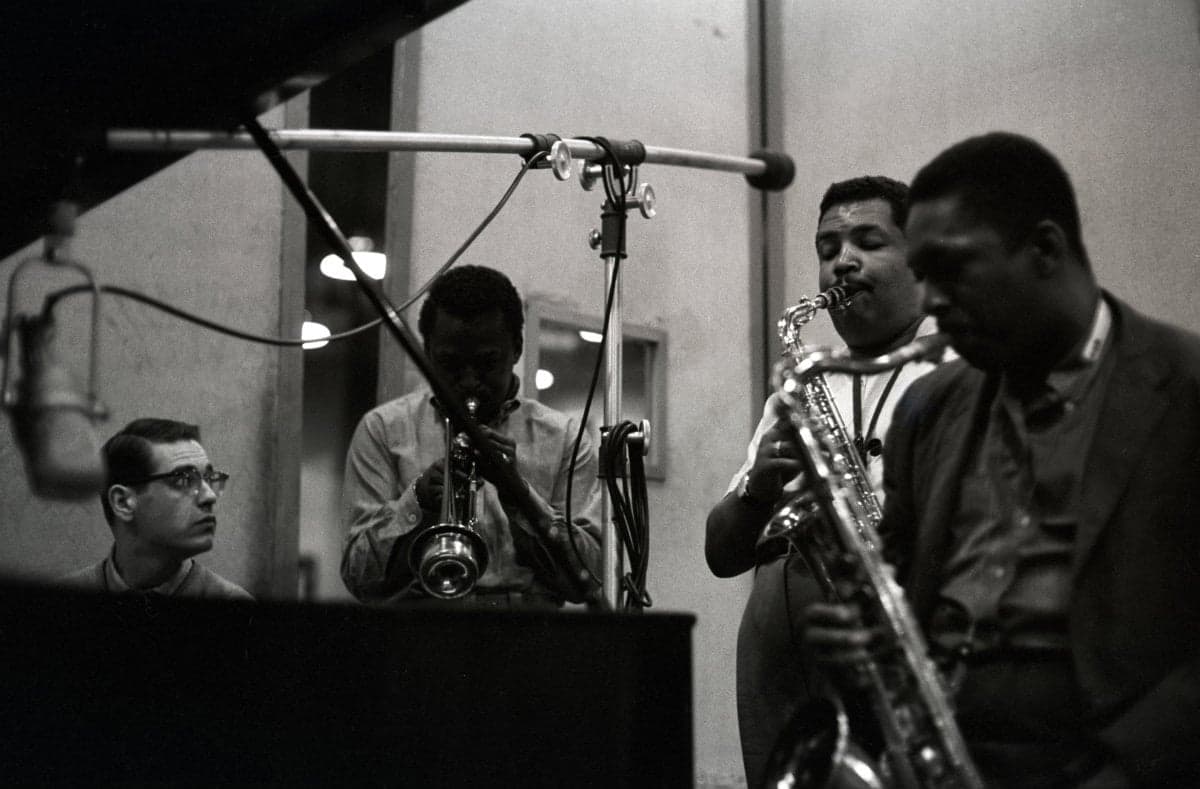
Kind of Blue was cut at Columbia's 30th Street Studio in New York, a converted church with a huge, live, natural room sound. Two sessions, one in March and one in April of 1959. "All Blues" came from the April date.
The band was ridiculous. Look at this personnel list and consider that they were all in the same room at the same time:
Miles Davis on trumpet, running the whole thing.
John Coltrane on tenor saxophone, a year or two away from becoming one of the most important musicians of the century in his own right.
Cannonball Adderley on alto saxophone, all warmth and blues feeling.
Bill Evans on piano, the guy who brought the impressionistic, harmonically deep touch that colors the whole album.
Paul Chambers on bass, the anchor.
Jimmy Cobb on drums, holding that rolling pulse.
Here's the part that should make anyone who's ever tried to make something feel a little insane. Miles barely gave the band anything to work with. He didn't hand out finished charts weeks in advance. He came in with sketches, scales, and a mood. He described what he wanted and let them find it in the moment. Most of the album, including "All Blues," was cut in a small number of takes. In some cases the first complete take is what you're hearing on the record.
That's not laziness. That's a deliberate bet. Miles wanted the sound of musicians discovering the music while they played it, not executing something they'd already worn smooth in rehearsal. The slight hesitations, the way the soloists feel their way into the open space, that's the point. You're hearing invention, not recitation.
As a builder, that decision terrifies and inspires me in equal measure. It's the opposite of how most people ship anything. But it only works when you've got that level of talent in the room and a leader who trusts them completely.
Bill Evans wrote the manifesto in the liner notes
The album cover carried liner notes by Bill Evans that quietly explained the entire philosophy, and they're worth knowing because they frame why this music worked.
Evans compared the improvisation on the album to a Japanese style of painting where the artist works on thin paper with a brush and ink, and any hesitation or correction ruins it. You commit to the stroke. You can't go back and touch it up. The discipline forces a kind of honesty.
That's exactly what Miles engineered by refusing to over-rehearse. The music had to be right the first time because there wasn't going to be a second try that meant anything. Evans understood that the modal approach and the recording approach were the same idea from two directions: create the conditions for spontaneous, committed expression, and then get out of the way.
Why this particular track earned its place in history
Plenty of records are historically important and nobody actually listens to them. That's not what happened here. "All Blues" and the album around it did three things at once, which is rare.
It proved the new approach was musical, not just theoretical
Modal jazz could have been a dry academic exercise. Scales instead of chords, very clever, who cares. Instead, "All Blues" is gorgeous. It's the kind of thing you can put on for someone who's never listened to jazz and watch them lean in. That mattered enormously. It showed that opening up the harmony didn't cost you feeling. It gave you more of it.
It changed what soloists were reaching for
Listen to Coltrane on "All Blues," then listen to what he did over the next few years. The modal space Miles opened up became the launch pad for Coltrane's own explorations. "A Love Supreme" doesn't happen the same way without the door "All Blues" and "So What" walked through. The whole idea of vamping on a mode and building intensity through repetition and development, rather than through harmonic navigation, becomes a foundation for the entire next era of jazz.
Cannonball's playing on the track is the other lesson. His solo is pure blues joy, and it shows that the modal setting didn't demand a cerebral, cool approach. You could still get down. The space worked for whatever you brought to it.
It reached people outside jazz
Kind of Blue is the best-selling jazz album of all time, and it keeps selling decades after everyone involved is gone. "All Blues" gets used in films, sampled, played in rooms where nobody could name the sax players. It crossed over without being dumbed down. The reason is that spaciousness. There's room in the music for a listener to exist inside it. Bebop asks you to keep up. "All Blues" invites you in.
The lesson underneath the music
I keep coming back to this record because the thing it did is a thing I recognize from my own work, and probably from yours.
Jazz in 1959 was on a track of adding complexity to solve every problem. More chords, more substitutions, more speed, more density. That's a very natural direction. When you're good at something, the obvious way to get better is to do more of it. More features. More technique. More stuff.
Miles looked at that and made the harder, less obvious call. He took things away. He simplified the harmony so the expression could get richer. He removed the obstacle course so the musicians could actually say something. The breakthrough wasn't addition. It was subtraction with a purpose.
I think about that constantly when I build. The instinct on every project is to add: another option, another animation, another clever bit of interaction, another field on the form. And most of the time the thing that actually makes a site or an app feel good is the opposite move. Take the clutter out. Slow the harmonic rhythm down. Give the user room to breathe and think and act. Let the important thing sit there without eight other things competing for attention.
"All Blues" is a 12-bar blues that anyone's grandfather would have recognized, played by six men who could have shredded through the most complicated changes ever written. They chose restraint instead, and it turned out to be the most influential choice in modern jazz. The confidence to keep it simple came from mastery, not from a lack of options. That's the part people get backwards. Simplicity that lands isn't the beginner's version. It's what you earn on the far side of knowing exactly how complicated you could have made it.
Go put the track on. Not in the background while you answer email. Actually sit with it for the ten minutes it runs. Listen to how much space there is between the notes, and notice that the space is doing as much work as the notes are. Then look at whatever you're building this week and ask what you could take out.