
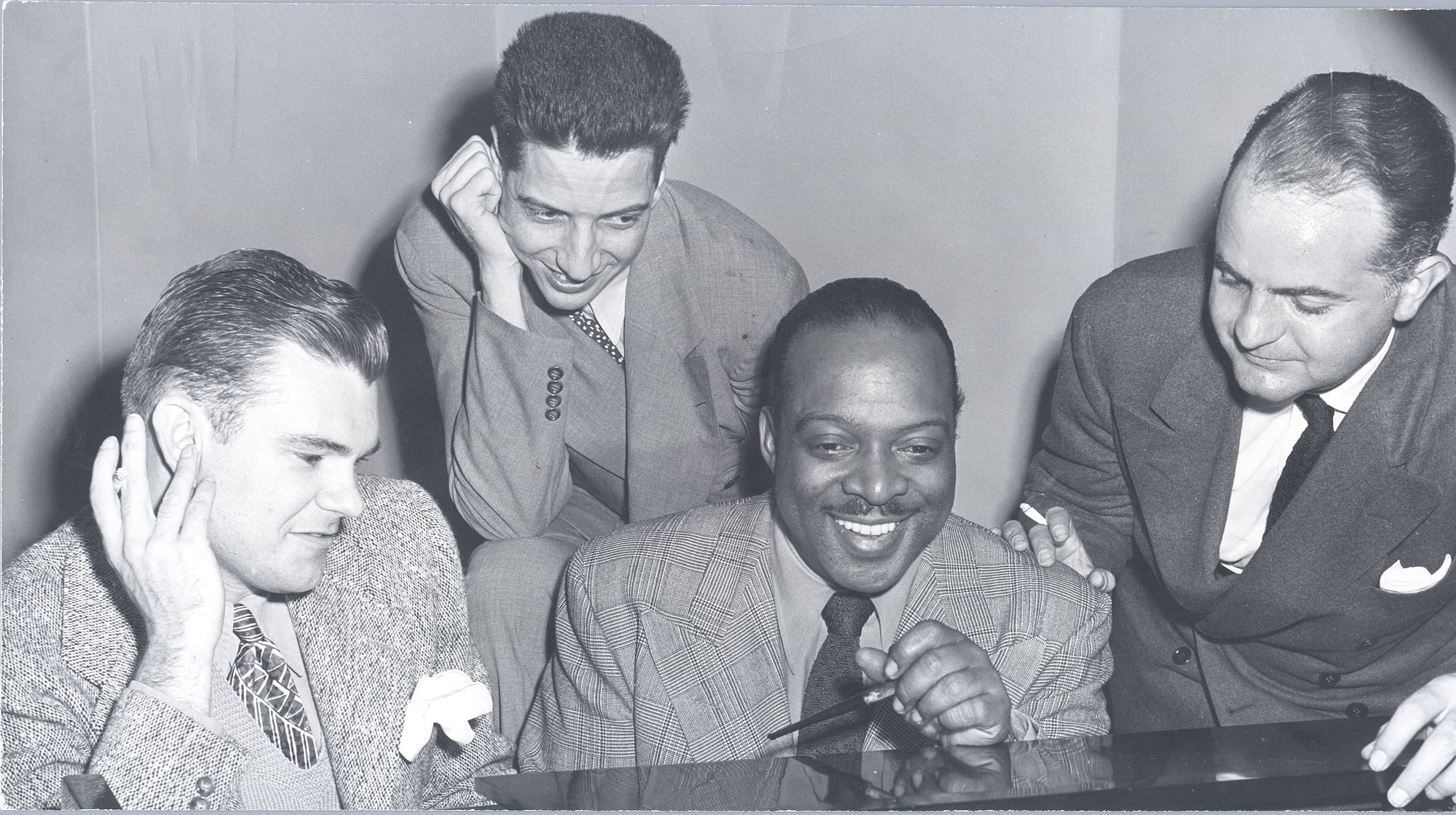
Most of the musicians who shaped 20th-century American music never signed their own record deals, never picked their own bandmates, and never decided which of their takes made it onto vinyl. Somebody else made those calls. In jazz, more often than you'd guess, that somebody was John Henry Hammond II — a Vanderbilt heir who could have spent his life doing nothing and instead spent it in Harlem clubs, control rooms, and courtrooms of public opinion, arguing that the best music in the country was being made by people the country refused to hear.
You can trace a startling amount of jazz history back to one man's ears and one man's stubbornness. Billie Holiday, Count Basie, Charlie Christian, Teddy Wilson, Benny Goodman as we know him — Hammond had a hand in all of it. And he did it while treating racial integration not as a marketing angle but as the whole point.
Here's the case for why he matters, and why the way he worked still holds up.
The rich kid who walked the wrong way uptown
Hammond was born in 1910 into serious money. His mother was a Vanderbilt. He grew up in a mansion on East 91st Street with a staff of servants and every door in New York society open to him. The expected path was Yale, a respectable career, a seat on some boards, a quiet life spending down an inheritance.
He blew all of it off.
By his late teens he was riding the subway up to Harlem to hear music that his social class considered beneath contempt. He dropped out of Yale. He started writing record reviews and columns, some for British music magazines because American outlets weren't interested in what he had to say. He used his own money — and he had plenty — to finance recording sessions for artists nobody else would touch.
That combination turned out to be rare and valuable. Hammond had the ear of a real critic and the bank account of a patron. He didn't need a hit to justify a session. He could record someone because he believed they were great, and worry about the market later, or never. Most people in a position to make records had to answer to sales. Hammond mostly answered to himself.
That independence is the thing to understand about him. It's why he could take bets nobody else would take.
Billie Holiday, recorded before anyone knew who she was
In 1933, Hammond heard a teenage singer in a Harlem club called Monette's. She was around 17. He came back night after night to hear her, then started telling everyone who'd listen that she was the best jazz singer he'd ever come across.
He put his money where his mouth was. He arranged for Holiday to record with a band led by Benny Goodman that November. She was a teenager with no track record. The records didn't exactly detonate. But those sessions are the beginning of the recorded Billie Holiday, and everything that came after — the phrasing that changed how singers approach a lyric, the work with Lester Young, "Strange Fruit" — starts from a door Hammond opened.
He kept opening it. Through the mid-1930s he produced a run of small-group sessions pairing Holiday with Teddy Wilson on piano and the best players he could assemble. These weren't big-budget productions. They were loose, cheap dates built around great musicians in a room. They're also some of the finest jazz vocal records ever made.
What Hammond understood — and a lot of producers still don't — is that you don't build a great record by controlling everything. You build it by putting the right people together and getting out of the way.
Count Basie, pulled out of Kansas City by a car radio
The Basie story is the one I'd put in front of anyone who thinks talent finds its own way to the top.
In 1936, Hammond was sitting in his car in Chicago, fiddling with the radio, and caught a late-night broadcast from the Reno Club in Kansas City. It was a nine-piece band led by a pianist named Bill Basie. Hammond was floored. Not a little impressed — floored. He decided, essentially on the spot, that this band needed to be in New York and needed to be recorded.
So he went and got them. He wrote about the band, pushed to get them a booking agent, helped move them east, and championed them relentlessly. There was a mess along the way — Basie had signed a bad deal with Decca that Hammond considered exploitative, and Hammond fought about it publicly — but the outcome is what matters. The Count Basie Orchestra became one of the defining big bands in jazz, and its rhythm section rewrote the rulebook for swing.
Think about the odds. Without a stray radio signal and a man obsessive enough to act on it, one of the greatest bands in American music might have stayed a regional act in a Kansas City club. Hammond didn't create Basie's genius. But he was the mechanism that carried it to the rest of the world, and mechanisms matter. Genius stuck in the wrong zip code stays a local secret.
Charlie Christian and the electric guitar
In 1939, Hammond got a tip about a guitarist in Oklahoma City named Charlie Christian. He sent for him — some accounts have Christian showing up in a green suit and yellow shoes, looking nothing like the New York scene — and then engineered one of the great ambush auditions in jazz.
Benny Goodman didn't want to hear an unknown kid. So Hammond planted Christian on the bandstand during a break at a Goodman gig. When Goodman kicked off a tune expecting the guy to fold, Christian instead played chorus after chorus that reportedly ran past twenty minutes and turned the whole room around. Goodman hired him.
That hire changed the instrument. Charlie Christian is the reason the electric guitar became a lead voice in jazz rather than a rhythm-section afterthought. His single-note lines pointed straight toward bebop; he was jamming at Minton's with the players who'd build the next revolution. He died of tuberculosis in 1942, only around 25 years old. The window was tiny. Hammond is the reason the window opened at all.
Forcing the color line, on stage and in the studio
Everything above would make Hammond an important talent scout. What makes him a genuinely significant figure is that he refused to keep his politics separate from his work.
Hammond was a lifelong civil rights activist. He sat on the board of the NAACP. And he treated the segregation of American music — Black musicians and white musicians recording separately, touring separately, forbidden from sharing a stage — as an injustice he was personally responsible for chipping away at.
The Goodman integration
Benny Goodman was, by the mid-1930s, the biggest name in popular music, "the King of Swing." Goodman also happened to marry Hammond's sister Alice, which tightened an already close and combative relationship between the two men.
Hammond pushed Goodman to put Teddy Wilson, who was Black, into his performing groups. First came the Benny Goodman Trio with Wilson on piano. Then Lionel Hampton joined on vibraphone, making it a quartet. This was a major white bandleader publicly performing alongside Black musicians in front of mainstream audiences in the 1930s. It was not normal. It was, for a lot of the country, provocative.
You can argue about how much credit goes to Goodman's own convictions versus Hammond's prodding. The honest answer is probably both. But Hammond was the one applying constant pressure, and the visibility of those integrated performances mattered enormously. Millions of people watched the most popular bandleader in America treat Black musicians as peers and equals on the same bandstand. That's a political statement whether anyone called it one or not.
From Spirituals to Swing
The clearest expression of Hammond's whole worldview was a pair of concerts he produced at Carnegie Hall, on December 23, 1938 and December 24, 1939, under the title "From Spirituals to Swing."
The idea was to present the full arc of African American music — gospel, blues, boogie-woogie, and swing — on the most prestigious stage in the country, treated with the seriousness that stage implied. He brought in gospel groups, blues singers, boogie-woogie pianists like Meade Lux Lewis and Albert Ammons, the Count Basie band, Sidney Bechet, and more. He'd wanted Robert Johnson, only to learn Johnson had recently died, so he found Big Bill Broonzy instead.
Put Carnegie Hall in context. This was a room built for European classical music, for an audience that would not have called what Hammond presented "art." He put it there anyway, in front of a mixed audience, and made the argument through the programming itself: this music belongs here, it is as serious and as American as anything you've applauded on this stage.
The concerts are now considered landmark events in the recognition of Black American music as art rather than entertainment. That recognition wasn't inevitable. Somebody had to force the door, and pay for the hall, and take the risk that the whole thing would be dismissed. Hammond did.
The Bessie Smith bookend
Here's a smaller story that says a lot about the kind of producer he was.
By 1933, Bessie Smith — the "Empress of the Blues," a massive star in the 1920s — had fallen out of fashion. The blues craze had cooled, the Depression had gutted the record business, and she wasn't recording anymore.
Hammond brought her back into the studio in November 1933 for what turned out to be her final recording session. He paid her, he assembled a band, and he got four sides down. She died in a car accident in 1937. Without Hammond, her recorded story simply ends earlier, on a lower note.
He did this kind of thing repeatedly. He cared about the music as a body of work worth preserving, not just as a pipeline of the next new thing. He'd track down a fading star because the records deserved to exist, market be damned.
What he got wrong
I don't want to hand you a saint, because Hammond wasn't one, and pretending otherwise makes the real story less useful.
He was opinionated to a fault, and his opinions could calcify into blind spots. When bebop arrived — the music Charlie Christian himself helped seed — Hammond largely didn't get it and didn't like it. He preferred the swing and blues traditions he'd grown up championing, and he could be dismissive of where the music went next. The great talent spotter aged into someone occasionally fighting the future.
He could also be controlling and self-mythologizing. He believed deeply that he knew what was best for the artists he worked with, and that certainty didn't always leave room for the artists' own ideas. Some of them found him overbearing. His public battles — like the fight over Basie's Decca contract — were righteous but also, at times, about Hammond being right as much as about the musician being served.
And it's worth naming the obvious tension: a wealthy white man positioning himself as the champion and gatekeeper of Black music carries real complications, no matter how sincere his convictions. Hammond used enormous privilege on behalf of people denied it. That's genuinely admirable. It also meant that access to some of the most important stages and studios in the country ran through the taste of one insider from the Vanderbilt family. Both things are true.
The second act, and why it proves the point
Hammond didn't stop when the swing era ended. His later career is almost absurd in its hit rate. At Columbia Records he signed Aretha Franklin in 1960. He signed Bob Dylan in 1961 — a move his colleagues mocked as "Hammond's Folly." He signed Leonard Cohen. In 1972 he signed Bruce Springsteen. In 1983 he championed Stevie Ray Vaughan.
I bring up the non-jazz signings because they close the argument about whether the jazz discoveries were luck. Nobody gets that lucky, across that many decades, in that many genres. Hammond had a repeatable skill: he could hear, early and clearly, when someone had something real, and he had the nerve to act before the consensus caught up.
That's the actual talent. Not being right once. Being willing to be right alone, in public, over and over, and putting resources behind the conviction.
What Hammond should teach the rest of us
I build websites and apps for a living, which is about as far from a 1938 Carnegie Hall stage as you can get. But I keep coming back to Hammond because the thing he was great at isn't really about jazz. It's about taste applied with courage, and it transfers to any field where somebody has to decide what's worth backing.
Three things stick with me.
Go where the work actually is. Hammond found Basie on a car radio and Christian on a tip from Oklahoma City. He didn't wait for talent to be pre-vetted and delivered to his desk with credentials attached. He went to the clubs, listened to the broadcasts, chased the rumors. The best stuff is almost never where the crowd is already standing. It's one zip code over, unsigned, waiting for someone to bother showing up.
Conviction is only worth something when it costs you. Anybody can champion a proven winner. Hammond recorded a 17-year-old with no career, brought a dying star back for one last session, and staked his reputation on a scruffy folk singer everyone told him to drop. He was willing to be wrong and willing to be mocked. If your endorsements never expose you to any risk, they don't mean much.
Refuse the false separation between the work and what's right. Hammond could have been a great scout while staying quiet about segregation. It would've been easier. Instead he made integration inseparable from the music, on the bandstand and at Carnegie Hall, and the two goals reinforced each other. The best work he did and the most decent thing he did were the same act.
Hammond died in 1987. The catalog he helped create — Holiday, Basie, Christian, Smith, and everyone downstream of them — is now foundational, the stuff people assume was always canonical and always safe. It wasn't. Somebody had to hear it first, believe it before it paid, and fight to get it in front of people who'd been told not to listen.
So the next time you're deciding whether to back something that isn't proven yet — a person, an idea, a piece of work everyone else is walking past — ask yourself the Hammond question. Not "will this succeed?" but "do I actually believe in this, and am I willing to be the only one who does for a while?" That's the whole job. He just happened to do it with the best music of the century.