
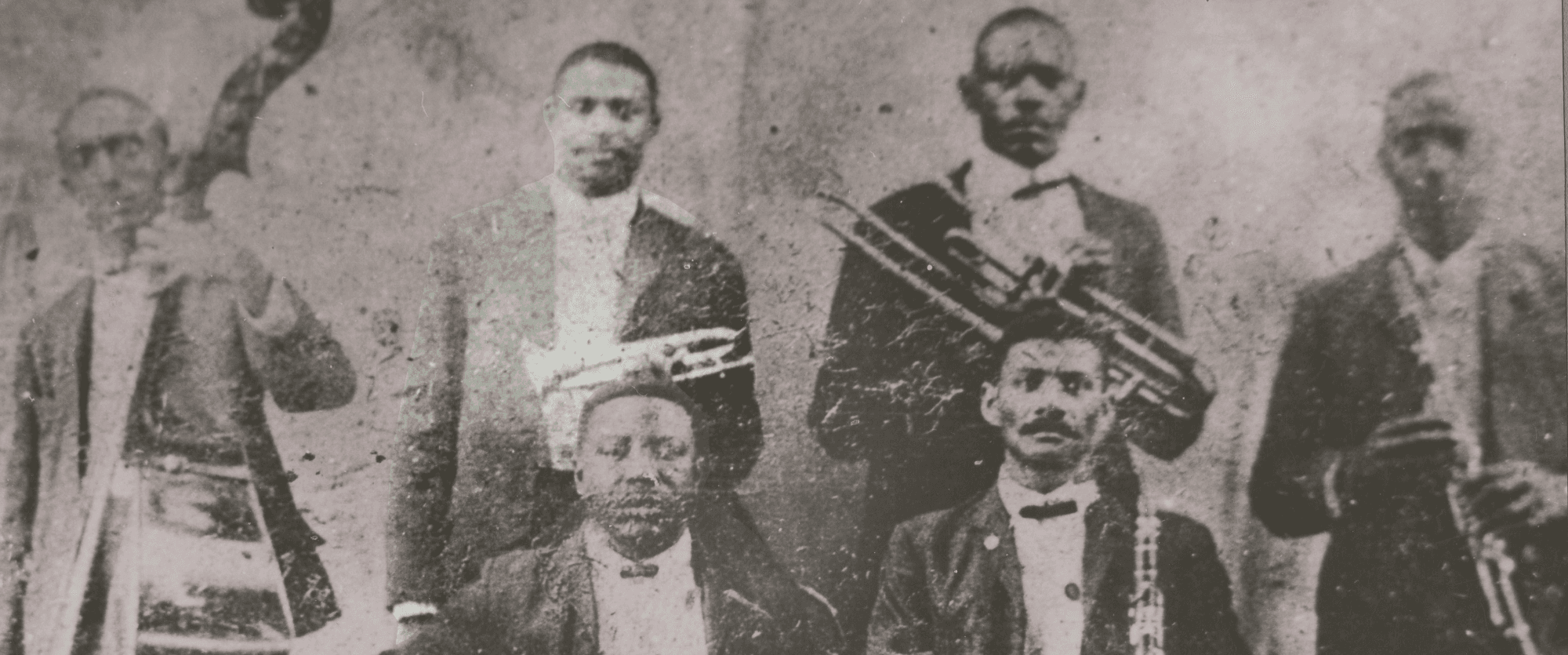
There's no recording of Buddy Bolden. Not one. The man who most historians point to as the first jazz musician left behind zero audio, a single blurry photograph, and a paper trail that mostly runs through a barbershop, a police report, and a mental hospital ledger. And yet almost everyone who came after him in New Orleans said the same thing: he started it. He built the thing the rest of them spent their careers refining.
I think about Bolden a lot, honestly. I build things for a living, and I know how it feels to make something that works and then watch other people improve on it while your name falls off the file. Bolden invented the rhythmic move that turned marching-band music into jazz, and he did it without leaving proof. So let's talk about the man, the invention, and why the Big 4 still matters more than a century later.
Who Buddy Bolden Actually Was
Charles Joseph "Buddy" Bolden was born in New Orleans on September 6, 1877. He grew up in a Black working-class part of the city in the years after Reconstruction collapsed, when the promise of equal footing was being clawed back by law and by force. That context matters. The music he made came out of a community that was being squeezed from every direction and made something joyful anyway.
He played the cornet. By most accounts he was loud, physically loud, the kind of player people claimed you could hear from miles away across the water. That's probably exaggeration, but exaggeration is itself a kind of evidence. People don't build tall tales around forgettable players.
He led a band around the turn of the century, roughly 1900 to 1906, and they were the band to beat in the rougher dance halls and parks of the city. He played places like the Union Sons Hall, which everyone called Funky Butt Hall after one of his tunes, and he pulled crowds at Lincoln Park and Johnson Park. There's a famous story that when business was slow at Johnson Park, he'd point his cornet out toward Lincoln Park and blast a few notes to pull the crowd over to him. Whether it's literally true doesn't matter. It tells you what people believed he was capable of.
He was also, apparently, a working man with a day job floating around him in the legend. The old story that he was a barber and published a scandal sheet has been mostly debunked by later research, but the myth stuck because it fit the picture people wanted: a charismatic local figure with his hands in everything, at the center of the neighborhood.
The Problem With No Recordings
Here's the frustrating part. The technology existed. Edison's cylinders were around. But nobody with a machine thought a Black dance-hall cornet player in New Orleans was worth capturing. There's a persistent rumor that Bolden's band made a cylinder recording somewhere around 1904, and that it's lost. People have hunted for it for decades. Nobody has found it. It may never have existed.
So everything we know about how Bolden actually sounded comes secondhand, from musicians who heard him as kids and told the story later. Louis Armstrong talked about him. Jelly Roll Morton talked about him, and demonstrated his style. Bunk Johnson claimed to have played with him, which historians now doubt, but the claim itself shows how much cachet Bolden's name carried decades after he stopped playing.
When your entire legacy is testimony, you have to weigh the witnesses. And the witnesses, even the unreliable ones, agree on one thing above all: Bolden broke the rhythm open.
What the Big 4 Is
Before Bolden, the popular music you'd hear at a New Orleans dance or parade was built on the march and on ragtime. Marches are stiff by design. They keep a steady two-beat pulse, ONE-two, ONE-two, so a column of people can walk in step. It's functional music. The rhythm is a metronome with a uniform on.
Ragtime added syncopation on top, mostly in the melody, in the right hand of the piano. But the underlying pulse still marched. The foundation stayed square.
Bolden's move was to attack the foundation itself. In a standard two-bar phrase, instead of playing the fourth beat of the second measure straight, he broke it up. He syncopated the last beat of the phrase, splitting it into a little rhythmic figure that pushed against the steady pulse and pulled you forward into the next phrase. That last beat, dressed up and syncopated, is the Big 4.
It sounds like a small thing. It is not a small thing.
Why Breaking One Beat Changed Everything
When you syncopate that fourth beat, you introduce tension and release into the rhythm itself, not just the melody. The music stops marching and starts swinging. Your body responds differently. You don't want to walk in a straight line, you want to move loose, off the beat, in conversation with it.
Wynton Marsalis has spent years demonstrating this for audiences, and the way he frames it has stuck with me. The Big 4 is the moment the parade stops being a parade and becomes a dance. It's the hinge. You can hear the exact spot where military precision turns into something human and swinging and free.
And once the rhythm section is free to break the beat, everybody upstream gets freer too. The horn player can float behind or ahead. The whole ensemble starts to breathe. Collective improvisation, the thing that would define New Orleans jazz, needs that rhythmic give underneath it. Without a flexible foundation, there's nothing to improvise against. The Big 4 built the flex.
This is why I say Bolden invented the platform, not just a song. He didn't write one clever melody. He changed the substrate everyone else would build on. That's a different order of contribution.
The Builder's Angle on the Big 4
I'm going to step out of pure history for a second, because this is where Bolden's story hits home for me as someone who makes things.
Most innovation people celebrate is additive. You take what exists and you pile on features, decoration, more. Ragtime was additive: keep the march, add syncopated melody on top. Nice, popular, safe.
Bolden's innovation was structural. He didn't add on top. He reached into the load-bearing part of the music, the thing nobody was supposed to touch, and he modified it. The rhythmic foundation was considered fixed. It was the wall you weren't allowed to move. He moved it.
I see the same split in my own field constantly. Anyone can add another section to a page, another animation, another plugin. The people who actually change things are the ones willing to question the foundation. Do we even need this layout convention? Why is this interaction built the way everyone builds it? That kind of move is riskier and less obvious, and it's the only kind that ever really matters.
The Big 4 is a masterclass in this. The smallest possible structural change, applied at exactly the right load-bearing point, cascading out into an entire art form. One beat. That's the whole trick. One beat, put in the right place, changed American music forever.
The Sound Nobody Could Copy on Paper
Part of why Bolden matters, and part of why he's so hard to pin down, is that his music wasn't written. It lived in the playing. The march-and-ragtime world was a world of sheet music, of composers, of things you could sell as printed pages. Bolden's contribution existed only in performance, in the feel, in the timing that a notation system couldn't fully capture.
You can write "syncopation" on a staff. You cannot write down the exact human timing that makes a Big 4 swing instead of just being a technically correct rhythm. It's in the microseconds. It's in the feel between players who've listened to each other for years. That's why the tradition had to be passed hand to hand, ear to ear, from Bolden's generation to Armstrong's and onward.
There's a lesson in that too. The most valuable thing Bolden made was the thing that couldn't be captured, copied, or sold as a product. It was a way of doing something, a sensibility, transmitted person to person. That kind of knowledge is fragile. It survives only if people keep doing it. Lose the practitioners and you lose the whole thing.
How It All Fell Apart
The hard part of the story comes fast. Bolden's peak was short. By 1906 he was showing serious signs of mental illness, with episodes of paranoia and erratic, sometimes violent behavior. There's an often-repeated account of him losing control during a street parade in 1906. Whatever the exact details, his condition deteriorated quickly.
In 1907, at just twenty-nine years old, he was committed to the East Louisiana State Hospital, a mental institution in Jackson, Louisiana. The diagnosis in the language of the time was dementia praecox, what we'd now understand as something in the range of schizophrenia.
He never came out. He spent the rest of his life, more than two decades, inside that institution. He died there on November 4, 1931, at fifty-four, and was buried in an unmarked grave in New Orleans. The exact location was lost.
Think about the timeline. He invented the rhythmic core of jazz, and then he was institutionalized before jazz even had a name, before the first jazz recordings were made in 1917, before Louis Armstrong grew up to carry the music around the world. He created the foundation and then vanished, alive but erased, while the entire edifice went up on top of what he'd built. He never heard what came of it.
How We Know Any of This
For a long time Bolden was more legend than documented person. The turning point was Donald M. Marquis and his book In Search of Buddy Bolden: First Man of Jazz, first published in 1978. Marquis did the unglamorous archival work: birth records, census data, city directories, hospital records, newspaper items. He separated a lot of myth from fact and gave us a real human being instead of a folk hero.
Some of what Marquis found deflated the legend. The barber-and-scandal-sheet stories don't hold up well. But the core held. Bolden was real, he led the most influential band in New Orleans at the birth of the music, and he was gone tragically young. The research didn't shrink him. It grounded him.
I have a lot of respect for that kind of work. It's easy to repeat a good story. It's hard to go verify it, to sit with microfilm and ledgers and chase down whether the thing everyone says is actually true. The Bolden we can talk about honestly today exists because someone did that patient, boring, essential work.
Why He Still Matters
You could argue that credit is impossible to assign cleanly here. Jazz didn't come from one man. It came from a whole city, a whole culture, thousands of people playing in bands and churches and parades and dance halls. That's true, and Bolden would probably be the first to say the music was in the air around him.
But inventions have origin points, and traditions have first movers, and the people who were there kept naming the same man. When Jelly Roll Morton and the early New Orleans players wanted to point at where the swing came from, they pointed at Bolden. That consensus among the people closest to it is the strongest evidence we've got, and it points one direction.
What I take from Bolden isn't sad, even though the ending is. It's this: the most important thing you make might be invisible in your own lifetime. Bolden never got a record, a royalty, a marked grave, or a single moment of hearing what his one-beat idea became. And it became one of the defining art forms of the twentieth century. The value was completely real and completely uncredited at the same time.
That should reframe how you think about your own work. Not everything worth doing pays off where you can see it. Some of the best things you build will get absorbed into the foundation, used by people who never learn your name, extended past anything you imagined. Bolden's beat is still playing every time a band swings. His name is on almost none of it, and it doesn't make the beat any less his.
So the next time you hear something that swings, listen for that hitch on the fourth beat, that little break that pulls you forward. That's a twenty-something cornet player from New Orleans reaching into the foundation and moving the wall everyone said couldn't be moved. Go build something that changes the substrate instead of decorating it. That's the only kind of work that outlives you, whether or not anyone remembers who did it.