
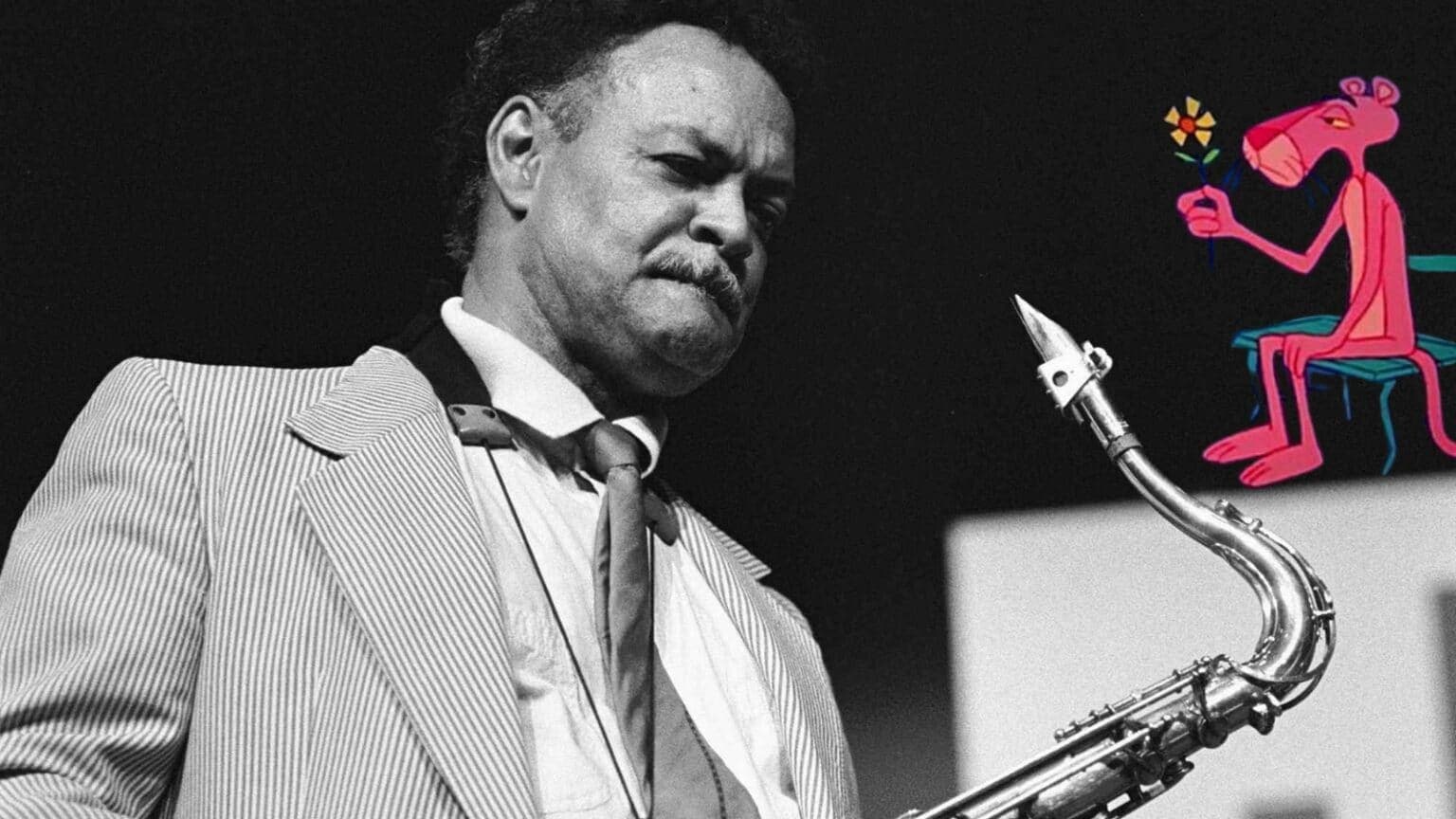
You've heard Plas Johnson play more times than you can count. You just didn't know it was him.
That prowling, greasy tenor saxophone on Henry Mancini's "The Pink Panther Theme" — the one that sneaks in behind the vibraphone and then struts across the whole arrangement — that's Plas Johnson. And that's the problem with being one of the best session musicians who ever lived. The work is everywhere, and your name is nowhere. The record label prints the singer's face. The composer collects the award. The horn player packs up his case and drives to the next date.
I think about this a lot, because I spend most of my working life doing the same thing. I build websites and apps that go out under somebody else's brand. The client's logo is on it. My name isn't. So when I look at a career like Johnson's — decades of showing up, playing the exact right thing, and letting other people take the credit — I don't see a footnote. I see a master class in how to have a career that lasts.
A kid from Louisiana with a horn in his hands
Plas John Johnson Jr. was born in 1931 in Donaldsonville, Louisiana, and grew up in New Orleans. That matters. New Orleans in the 1930s and '40s wasn't a place you studied music. It was a place you absorbed it. Brass bands on the street, R&B on the radio, church music, blues, everything soaking into you before you were old enough to name it.
His family was musical. He and his older brother Ray — a pianist — played together early, working local gigs as kids. That's the kind of apprenticeship you can't fake. By the time most players are taking their first lessons, Johnson had already logged real hours in front of real audiences who would let him know, immediately, if he wasn't cutting it.
He came up on the alto first, then moved to tenor, which is where he found his voice. And "voice" is the right word. From early on, Johnson's playing had that vocal, speaking quality — the sense that the horn was saying something specific rather than just running notes. He toured with Charles Brown, the blues and R&B singer, which put him in front of crowds who wanted feeling over flash. That schooling shows up in everything he recorded later.
Then he made the move that defined the rest of his life. In the early 1950s he headed to Los Angeles.
Landing in the middle of the machine
The timing was almost unfair. Johnson arrived in L.A. right as the recording industry was exploding. Rock and roll was about to break wide open. R&B was crossing over to white audiences. Television needed music. Film scores were getting bigger and busier. And all of it ran through a small pool of studio musicians in Los Angeles who could walk in cold, read a chart, and nail it on the first or second take.
That was the job. And Johnson turned out to be exceptionally good at it.
Session work is a brutal filter. You're paid by the hour, and studio time is expensive, so nobody wants a player who needs six takes to warm up. You have to sight-read anything, in any style, and play it with conviction the first time the tape rolls. You have to sound like a blues honker on one date and a smooth ballad player on the next, sometimes on the same afternoon. And you have to do it without ego, because your job is to serve the record, not to show off.
Johnson became one of the go-to tenor players in the city. He worked for Capitol Records, among others. He played on rock and roll sides, R&B hits, pop ballads, jazz dates, film and TV scores. He was part of the loose, uncredited community of Los Angeles studio pros — the same scene that later got romanticized as "the Wrecking Crew" — whose fingerprints are on an absurd number of records you already know by heart.
Here's the part that always gets me. If you tried to make a complete list of the recordings Plas Johnson played on, you couldn't. Nobody could. Session players in that era weren't credited. The dates were logged as union paperwork, not liner notes. So his real body of work is scattered across thousands of records under names that aren't his. That's not a tragedy. That's the shape of the career. He chose the work over the spotlight, over and over, and the work kept coming.
The sound
You can talk about a musician's résumé all day, but with a player like Johnson the résumé isn't the point. The sound is the point. And his tenor sound is one of the most recognizable in American music, even to people who have no idea whose it is.
It's big. It's warm. There's a rasp at the edges, a little grit, but never so much that it turns into noise. He could play breathy and intimate on a ballad, then dig in and honk on an R&B track without it feeling like two different people. That range is rare. A lot of players own one thing — the smooth thing or the raw thing — and build a whole career on it. Johnson owned the whole spectrum and could dial it in to fit whatever the date needed.
Feel over fireworks
What separates Johnson from a thousand competent studio horn players is restraint. Listen to his solos and notice how little he wastes. He'll leave space. He'll bend one note and let it hang there instead of stuffing the bar with runs. He plays like someone who understands that the emotion lives in the notes you don't play as much as the ones you do.
That's a hard lesson, and not just for musicians. Most people early in any craft over-deliver because they're afraid silence reads as incompetence. So they cram everything in — every technique they know, every clever move — to prove they belong. The pros do the opposite. They cut until only the necessary is left. Johnson had that discipline decades deep. He knew exactly how much was enough, and he stopped there.
Reading the room
The other thing that made him valuable was taste — knowing what the song wanted. A session player who imposes his own style on every date doesn't get called back. A session player who disappears into the material, who makes the artist and the arranger sound better, gets called constantly. Johnson was the second kind. He wasn't trying to turn a pop record into a Plas Johnson record. He was trying to make the pop record great. That instinct is worth more than technique, and it's a lot harder to teach.
The Pink Panther
Then came 1963, and the one time the invisible man got put front and center — sort of.
Henry Mancini was scoring the Blake Edwards film The Pink Panther, and he wrote a theme built around a tenor saxophone. Mancini knew exactly who he wanted. He wanted Plas Johnson. He wrote that melody with Johnson's sound in his ear — that sly, walking, half-comic, half-cool line that has since become one of the most instantly recognizable pieces of music on the planet.
Think about what that means. Mancini could have hired any saxophonist in Los Angeles. He specifically wanted the tone and the phrasing that only Johnson had. The instrument itself became a character in the film. The theme isn't just "saxophone." It's that saxophone, played that way, by that man. You can't separate the composition from the performance. They're welded together.
And here's the beautiful irony. The theme made the sound famous and left the player anonymous. Ask a hundred people to hum "The Pink Panther Theme" and most of them can do it. Ask those same people who played the sax and you'll get blank stares. The performance is immortal. The performer is a trivia answer.
I don't think Johnson lost sleep over that. When you've built your whole life around serving the work, having your best-known solo attached to a cartoon panther and a Mancini credit is just the job doing what the job does. But it's a perfect illustration of the trade every craftsman makes. Your work can outlive you and outgrow you and still not carry your name. You have to decide whether that's enough. For Johnson, clearly, it was.
Records under his own name
Johnson wasn't only a hired gun. He made records as a leader, too, and they're worth seeking out precisely because they show you the player when he's the point instead of the accompaniment.
This Must Be the Plas! came out on Capitol in 1959 and leans into exactly what you'd hope — swaggering, blues-soaked tenor with a rhythm section behind it. It's not trying to be avant-garde. It's not chasing the cutting edge of jazz that was happening at the same moment with players like Coltrane and Rollins. It's Johnson doing the thing he does better than almost anyone: playing melody with a huge, human tone and a deep sense of groove.
Later, in the 1970s, he recorded for Concord Jazz, including sessions that put his blues and swing playing front and center for listeners who wanted to hear the man stretch out. These aren't records that reinvented the music. They're records that document a great player being great, unhurried, without a producer telling him to hold back so the vocal can sit on top.
I want to be honest about something here. Johnson's leader dates never made him a household name, and they were never going to. The jazz world of critics and canon-makers tends to reward innovation — the players who broke the rules and pushed the form somewhere new. Johnson wasn't that. He was a supreme executor of an existing tradition. And the culture has always undervalued the executor next to the innovator. That's a bias worth questioning. Doing something new isn't automatically better than doing something well. Sometimes it's just newer.
The long career
What impresses me most about Johnson isn't any single record. It's the duration. He didn't have a hot decade and then fade. He kept working — decade after decade after decade.
He played in television bands, including long stretches of steady studio and broadcast work that most musicians would kill for. He turned up in big bands around Los Angeles. He toured. He kept recording. He was still performing live well into his seventies and beyond, in an era when most of his session-era peers had retired or passed. He outlasted whole styles of music and kept finding a place to play.
That kind of longevity doesn't happen by accident, and it doesn't happen on talent alone. It happens because of the things that surround the talent — reliability, professionalism, being easy to work with, showing up on time and prepared. In session work, your reputation is your entire business. One flaky date, one bad attitude, one blown session that costs a producer money, and the phone stops ringing. Johnson's phone rang for fifty years. You don't get that unless people trust you completely.
Why the boring virtues win
I keep coming back to this because it maps so directly onto the work I do. The flashy stuff — the raw ability, the one iconic solo — gets the attention. But careers are built on the unglamorous foundation underneath it. Being dependable. Delivering what the project actually needs instead of what shows off your skills. Making the client look good. Being someone people want to work with again.
Nobody writes a documentary about that. But it's the thing that separates a working professional from a talented person who ran out of runway. Johnson had the talent, sure. Plenty of people had talent. What he also had was the discipline to make the talent pay, over and over, for half a century. That's the rarer gift.
What a session man teaches the rest of us
Here's what I take from Plas Johnson's career, and it's got almost nothing to do with saxophones.
The work outlives the credit, and that has to be okay. If you need your name on everything you touch, you'll drive yourself crazy in any service business. The value you create doesn't disappear just because someone else's logo is on it. The "Pink Panther Theme" is Plas Johnson whether or not the world remembers his name. Your best client project is your work whether or not anyone knows you built it. Make peace with that early, or find a different line of work.
Range beats specialization more often than people admit. Johnson could play a whisper or a honk, a jazz date or a rock and roll session, a film score or a blues record. That flexibility is why he never ran out of work. The specialists get one wave and then the wave passes. The versatile ones ride every wave. In my field the parallel is obvious — the developer who only does one framework is one industry shift away from irrelevance.
Restraint is a skill, not a weakness. The temptation to over-deliver, to prove yourself by doing more, never fully goes away. But the pros cut. They give the project exactly what it needs and stop. That confidence — knowing when enough is enough — reads as mastery, because it is.
Reliability compounds. One great performance gets you a gig. A thousand dependable performances gets you a career. Johnson built his life on being the guy who always delivered, and that reputation paid dividends for fifty years. There's no shortcut version of that. You just do good work, consistently, for a long time, and let it accumulate.
So the next time that sax sneaks in on the "Pink Panther Theme," give it a second listen and think about the man behind it. Then go be that in your own field — the pro whose fingerprints are all over the work, whether or not your name ever makes it onto the label. That's not a consolation prize. For the people who actually love the craft, it's the whole point.